1. Why Vietnam Has Become a Global Hub for Bulk Agricultural Products
Vietnam’s rise as an agricultural exporter reflects decades of investment in farming systems, processing capacity, and trade infrastructure. The country ranks second worldwide in coffee exports, second in black pepper, and consistently among the top three rice exporters. Cashew processing leads the globe, with Vietnam handling a large share of raw nuts sourced internationally.
Several structural advantages support this position. A long coastline hosts deep-water ports, fertile river deltas yield multiple harvests per year, and free trade agreements such as the EVFTA, CPTPP, and RCEP lower tariffs across major markets. These factors combine to give buyers competitive pricing and reliable volume.
The table below compares Vietnam with other leading agricultural exporters across key commodities.
| Commodity | Vietnam | India | Indonesia | Brazil | China |
| Coffee | #2 global | Minor | #4 global | #1 global | Minor |
| Black Pepper | #1 export | #3 | #2 | Minor | Minor |
| Rice | Top 3 export | #1 export | Importer | Minor | Importer |
| Cashew | #1 processor | #2 | Minor | Minor | Minor |
This breadth across multiple categories distinguishes Vietnam from competitors that concentrate on one or two crops. The next section details the specific products that buyers source from the country.
2. What Bulk Agricultural Products Does Vietnam Export?
Vietnam’s export catalog spans staples, stimulants, and specialty spices. Each carries its own grading conventions and target markets.
Coffee anchors the export economy. The Central Highlands provinces of Dak Lak, Lam Dong, and Gia Lai produce the bulk of the nation’s Robusta, prized for body and caffeine content, while northern regions yield smaller volumes of Arabica. Buyers source green coffee for roasting abroad and finished roasted coffee for retail. Principal destinations include the EU, the United States, and Japan.
Rice moves in large tonnage to the Philippines, Africa, and China. White rice serves volume markets, while fragrant varieties such as Jasmine and the award-winning ST25 command premium pricing. Export standards specify broken-grain percentages, moisture limits, and milling degree, allowing buyers to match grade to purpose.
Black Pepper comes primarily from the southern provinces. It ships as black, white, ground, and sterilized grades, with quality measured by bulk density, expressed in grams per liter, and piperine content. Steam sterilization meets the microbiological standards required by European and American importers.
Cashew Nuts reflect Vietnam’s processing leadership. Kernels are classified by size and color, with W180, W240, and W320 among the most traded grades. The numbers indicate kernel count per pound, where lower figures denote larger nuts. As an illustration, Nông Sản Vũ Công sorts export-grade kernels by whiteness, breakage rate, and moisture, then packages each grade to buyer specification.
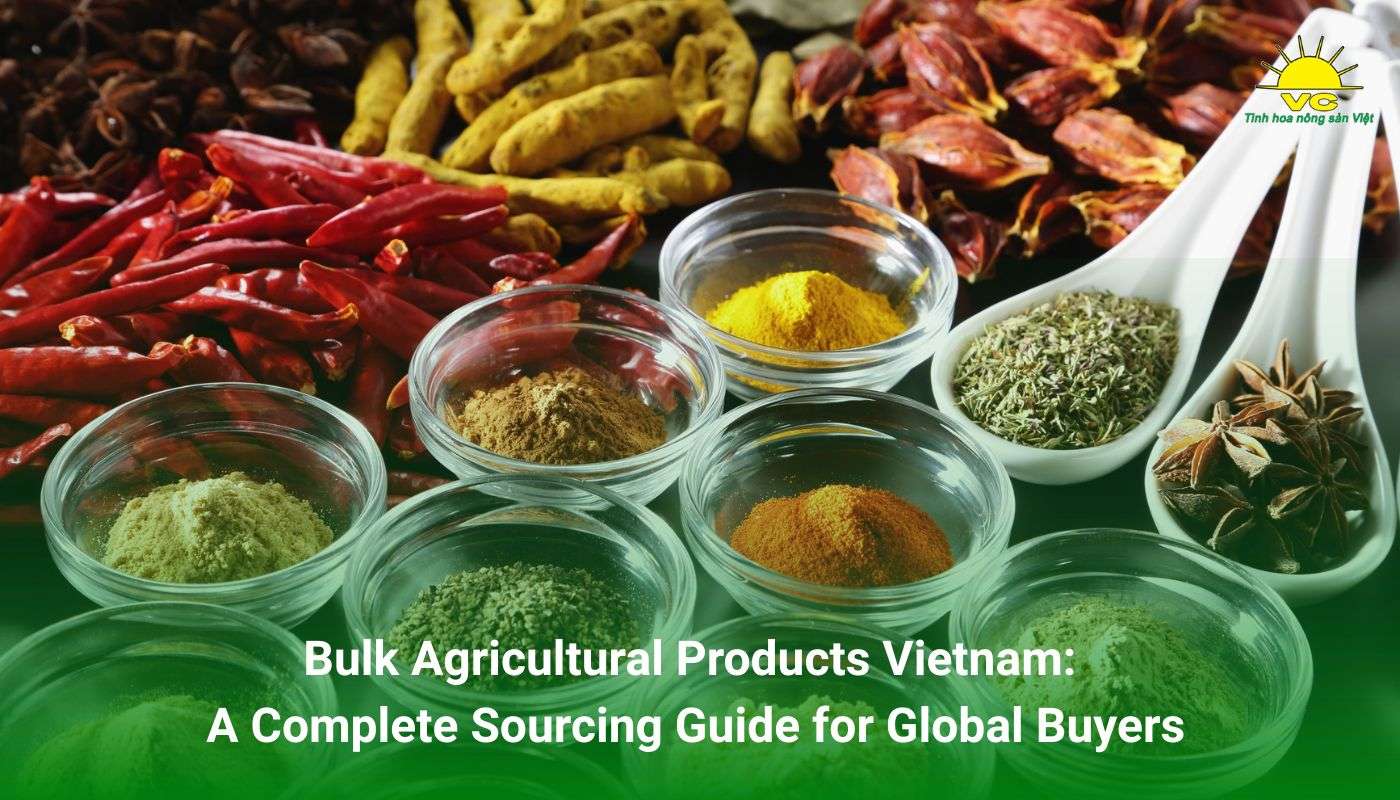
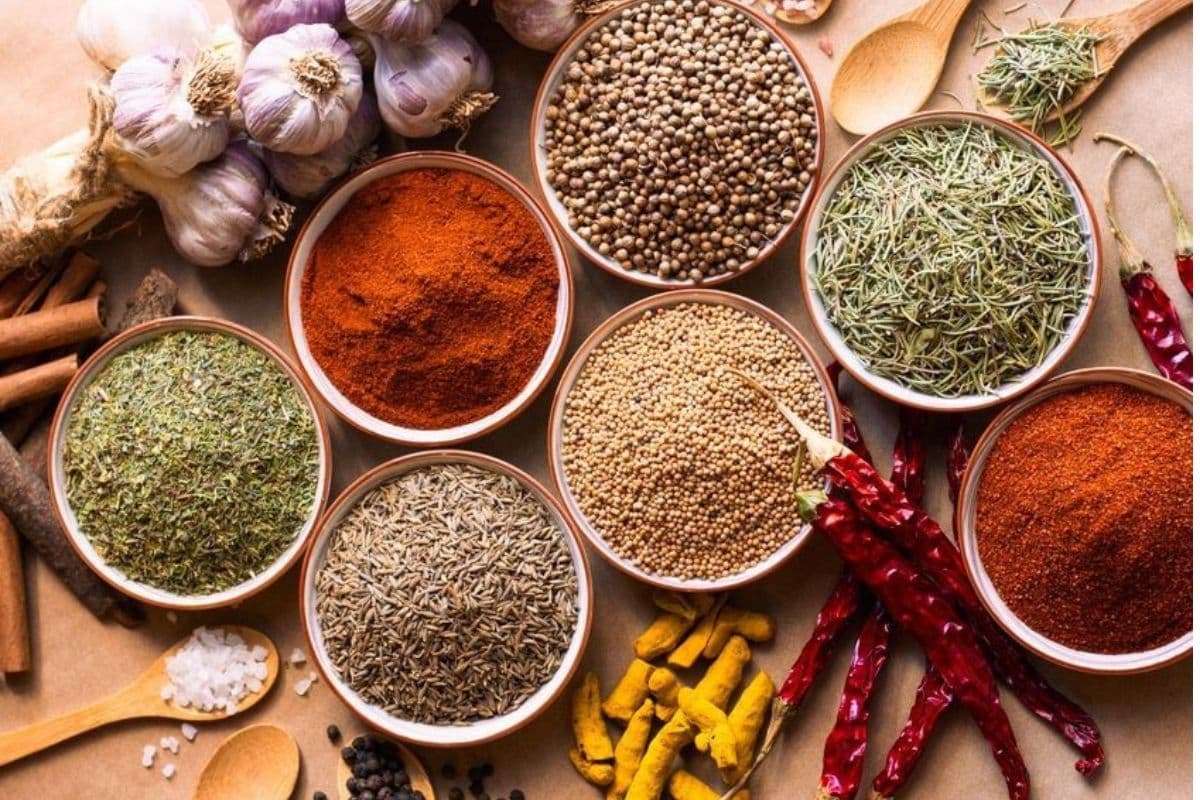
Cinnamon and Star Anise grow in the northern uplands, where Yen Bai and Lang Son supply distinctive aromatic profiles. Oil content and moisture levels determine value, and organic certification opens premium channels in the EU and North America. Vũ Công processes these spices under controlled drying to preserve volatile oils.
| Product | Key Grades | Primary Markets |
| Coffee | Robusta, Arabica | EU, US, Japan |
| Rice | White, Jasmine, ST25 | Philippines, Africa, China |
| Black Pepper | Black, White, 500–550 g/l | EU, US, Middle East |
| Cashew | W180, W240, W320 | US, EU, China |
| Cinnamon/Star Anise | Organic, conventional | EU, US, India |
Knowing the products is one matter; locating dependable suppliers is another.
3. How to Find Reliable Agricultural Suppliers in Vietnam
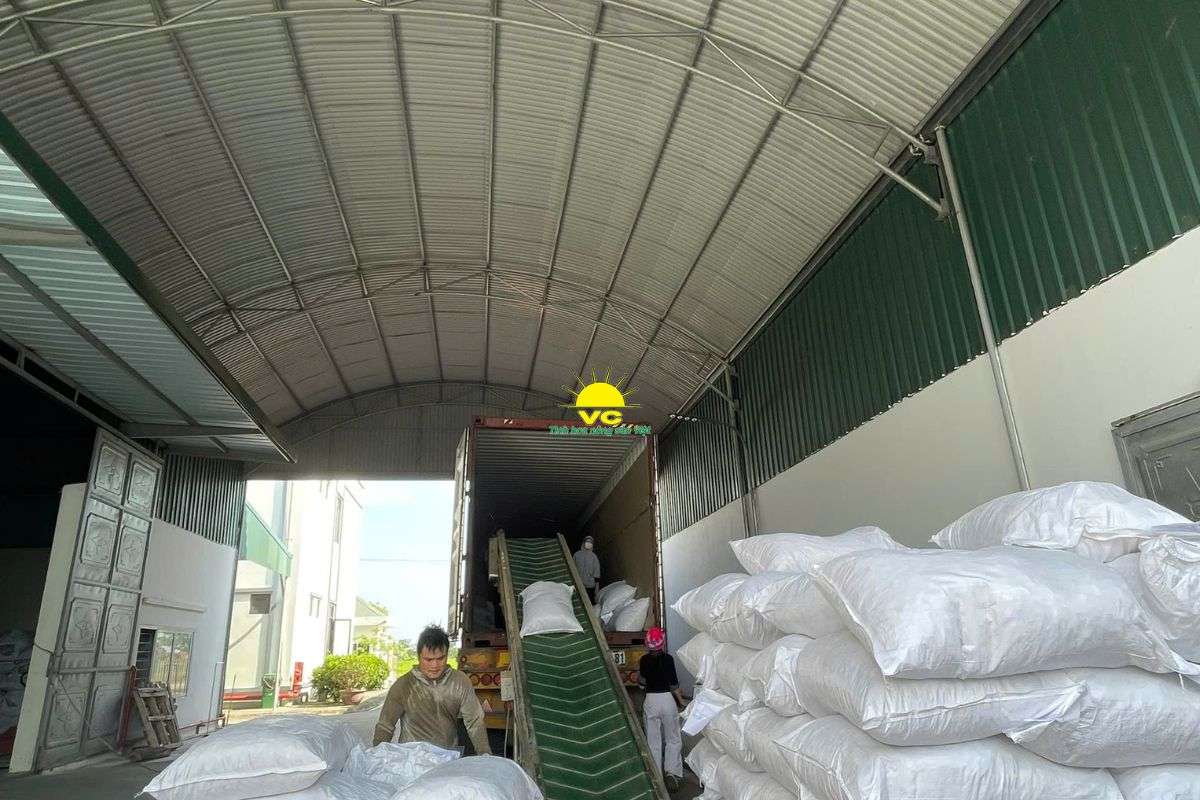
A sound sourcing decision rests on understanding who you are dealing with, confirming their legitimacy, and measuring their capacity.
Understanding the different types of suppliers clarifies expectations. Individual farmers offer raw material but limited processing. Cooperatives aggregate output from many growers and improve consistency. Factories handle cleaning, grading, and packaging. Exporters and trading companies manage documentation, logistics, and international compliance. Many buyers prefer integrated processors that combine farming oversight with export capability, reducing the number of intermediaries.
Verifying supplier legitimacy protects against risk. Before placing an order, request and confirm the following:
- Business registration certificate issued by Vietnamese authorities
- Valid export license for the relevant commodity
- Client references from existing international buyers
- Compliance records, including audit reports and certification copies
Cross-checking these documents against public registries adds a layer of assurance.
Evaluating production capacity determines whether a supplier can meet your volume reliably. Useful indicators include factory floor area, annual output in metric tons, quality control systems, and storage facilities with humidity management. A buyer assessing Nông Sản Vũ Công, for example, would review its processing lines, in-house laboratory checks, and warehouse conditions to confirm that order size and delivery schedule align with stated capability.
| Evaluation Criterion | What to Confirm |
| Legal status | Registration, export license |
| Track record | References, years in operation |
| Capacity | Annual output, factory size |
| Quality control | QC lab, testing protocols |
| Storage | Climate-controlled warehousing |
Verified suppliers still need to demonstrate compliance through recognized certifications, which the next section explains.
4. Agricultural Export Certifications Buyers Should Understand
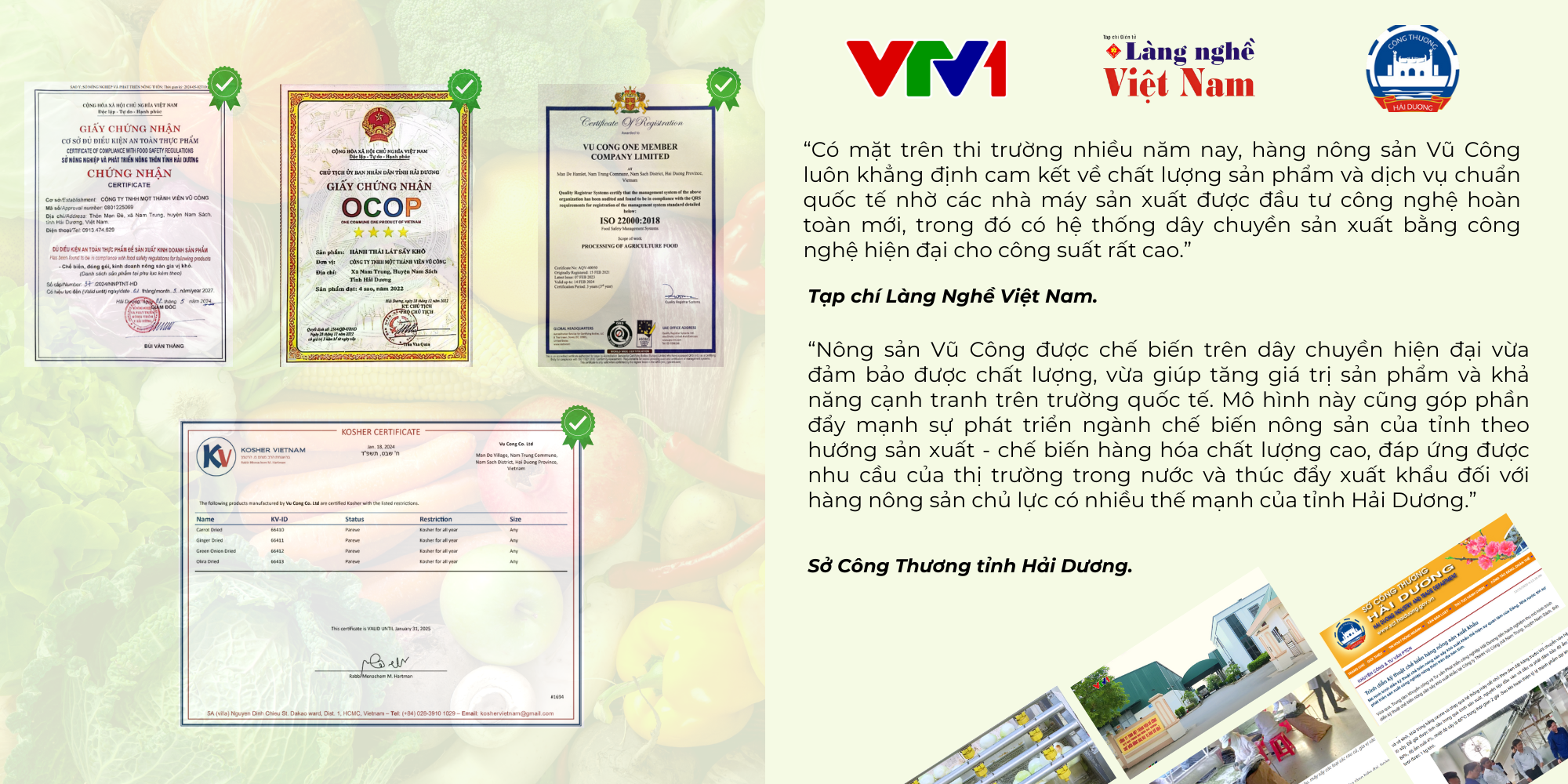
Certifications translate quality and safety claims into verifiable standards. They reduce uncertainty and, in many markets, serve as a precondition for entry.
Food safety certifications address handling and contamination control. HACCP identifies and manages hazards throughout processing. ISO 22000 extends this into a complete food safety management system. Kosher certification serves religious dietary markets and signals disciplined production hygiene.
Sustainability certifications respond to growing buyer and consumer expectations. Organic certification confirms cultivation without synthetic inputs. Fair Trade verifies equitable returns to farmers. Rainforest Alliance addresses environmental stewardship and labor practice. These credentials frequently unlock premium pricing in the EU and North America.
Product traceability ties every shipment back to its origin. A documented farm-to-export workflow records the harvest location, processing batch, quality test, and shipping data. Vũ Công maintains traceability files that link each export lot to its source region, allowing buyers to audit the chain when required. Additional detail is available at vucongagro.com.
| Certification Type | Examples | Buyer Benefit |
| Food Safety | HACCP, ISO 22000, Kosher | Market access, hazard control |
| Sustainability | Organic, Fair Trade, Rainforest Alliance | Premium pricing, brand value |
| Traceability | Farm-to-export records | Audit readiness, recall control |
With supplier and certification questions settled, attention turns to moving goods across borders.
5. Logistics and Shipping Considerations for Bulk Agricultural Exports
Efficient logistics determine whether quality product reaches buyers in sound condition and on schedule.
Major export ports give Vietnam strong outbound capacity. Cat Lai in Ho Chi Minh City handles the largest container volume and serves southern producers of rice, cashew, and pepper. Hai Phong in the north connects upland spice regions to East Asian markets. Da Nang offers a central option for balanced distribution. Selecting the port nearest the production zone shortens inland transport and lowers handling cost.
Shipping transit times vary by destination, and planning around them prevents stock gaps. The estimates below reflect typical container shipping durations.
| Destination Region | Estimated Transit |
| Asia-Pacific | 5–12 days |
| Middle East | 14–20 days |
| Europe | 25–35 days |
| North America | 20–35 days |
Packaging and cargo protection preserve quality across these distances. Agricultural goods are sensitive to moisture, pests, and temperature swings. Effective protection involves moisture-barrier liners, food-grade jute or polypropylene sacks, vacuum sealing for select products, and fumigation where required. Container desiccants control condensation during long ocean transit. Vũ Công, for instance, applies moisture-controlled packaging with sealed liners for cashew and spice shipments, guarding aroma and texture until the cargo reaches its destination.
Reliable logistics support the larger goal: a sourcing strategy that holds up over years, not single orders.
6. Building a Long-Term Agricultural Sourcing Strategy in Vietnam
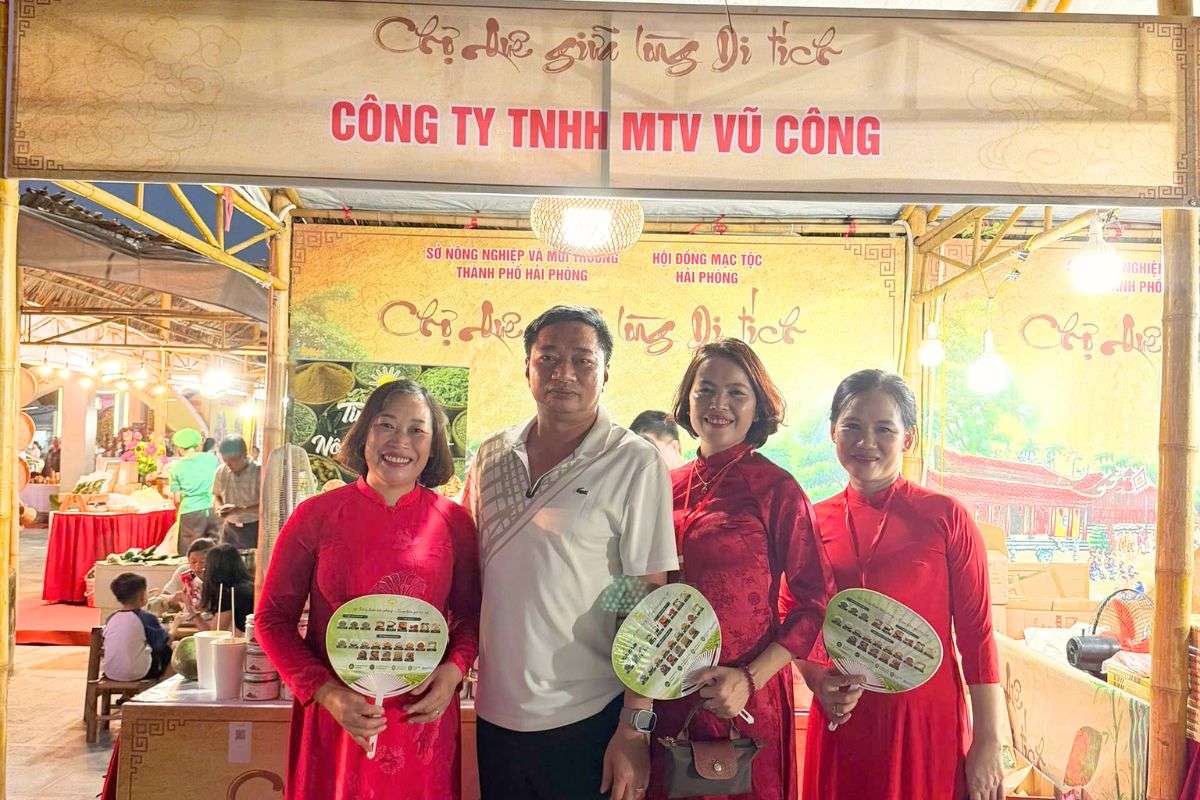
Sustained supply depends on structure as much as on individual transactions. Several models help buyers balance security, cost, and flexibility.
Single supplier versus multi-supplier approaches each carry trade-offs. A single partner simplifies communication, builds shared standards, and often improves pricing through loyalty. Multiple suppliers spread risk across harvests and regions, protecting against weather disruption or local shortfall. Many buyers blend the two, anchoring volume with a primary processor while keeping secondary sources active.
Contract farming strengthens stability. By committing to volume ahead of harvest, buyers secure supply and give growers predictable demand. This arrangement supports consistent quality, since farming practices can be agreed in advance.
Private label and OEM opportunities allow buyers to build their own brand on Vietnamese product. Processors capable of custom packaging, blending, and labeling enable distributors to differentiate in their home markets without operating a factory.
Scaling procurement while maintaining quality requires durable relationships. As order size grows, consistency becomes harder to hold. Working with an export-ready processor such as Nông Sản Vũ Công, which combines farming oversight, in-house quality control, and flexible packaging, helps buyers expand volume without sacrificing the standards that secured their market in the first place.
7. Turning Vietnam’s Agricultural Export Strength Into a Reliable Long-Term Supply Chain
Vietnam offers global buyers a rare combination: breadth of product, competitive cost, favorable trade access, and growing processing sophistication. Converting that strength into a dependable supply chain rests on disciplined decisions at each stage.
The core principles are straightforward:
- Match product grade to your market, using clear export standards
- Verify every supplier’s legal status, references, and capacity before committing
- Require certifications appropriate to your destination and customers
- Plan logistics around port location, transit time, and cargo protection
- Build relationships that scale, favoring partners with integrated quality control
Risk management threads through all of these steps. Document checks reduce legal exposure, certifications guard against rejection at customs, and multi-source planning cushions seasonal volatility. Together they turn isolated purchases into a resilient system.
For buyers seeking a foundation, partnering with an export-ready processor such as Vu Cong Agro offers traceable product, controlled processing, and packaging built for long-distance transit. Approached methodically, sourcing bulk agricultural products from Vietnam becomes not a gamble but a measured, repeatable advantage.
Read more:
- 5 Golden Standards for Choosing a Dried Vegetable Wholesaler
- Vu Cong Company – A Trusted Vietnam Agricultural Products Supplier