

Onion is one of the few ingredients that appears in almost every cuisine, yet fresh bulbs travel poorly, spoil quickly, and vary in strength from harvest to harvest. Dehydration solves that problem. Vu Cong Dried Onion Flakes are produced from Vietnamese-grown onion bulbs, sliced and moisture-reduced under controlled conditions to deliver a stable, measurable ingredient for industrial kitchens and food manufacturers. This page explains what the flake format is, how processors use it, and what Vũ Công can document about the way it is made.
1. What Are Vietnamese Dried Onion Flakes?
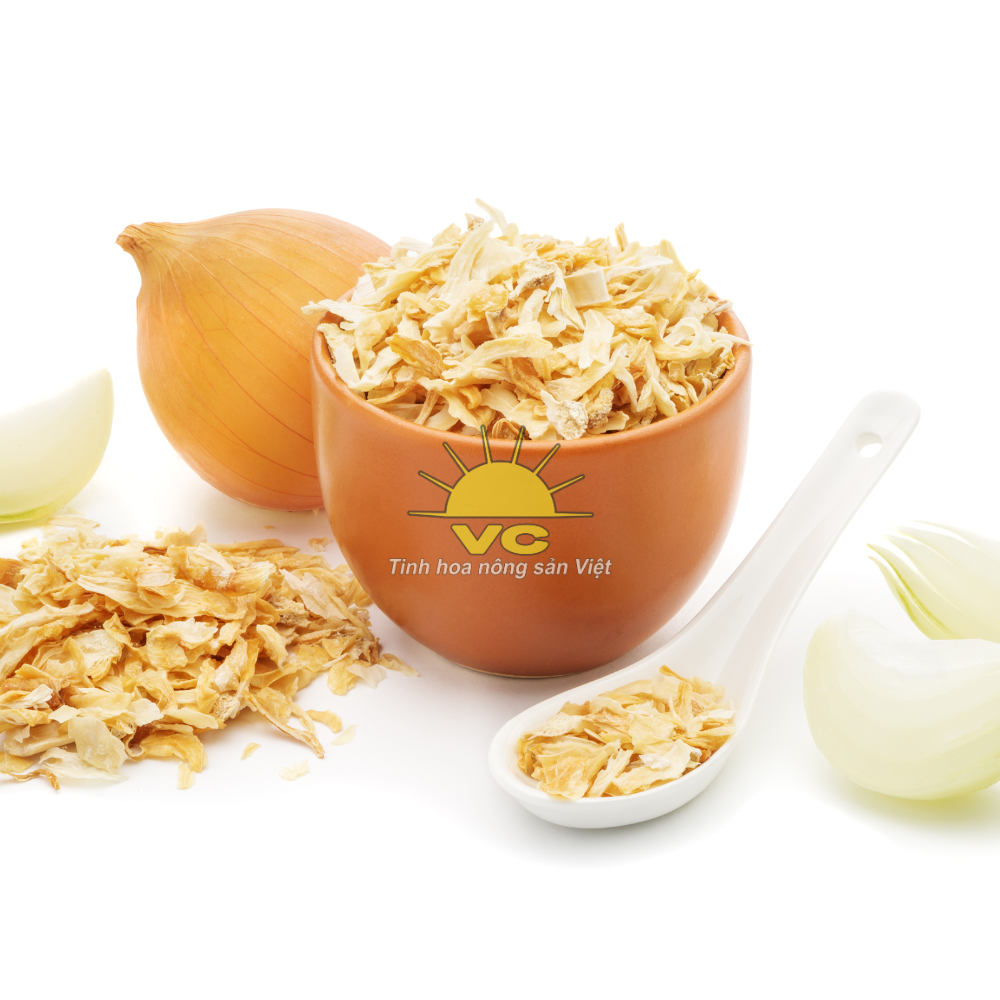
Dried onion flakes – also written as dehydrated onion flakes – are peeled onion bulbs that have been sliced into thin pieces and dried until moisture content falls to roughly 6–8%. At that level, water activity drops below the threshold at which most spoilage microorganisms and enzymes remain active, which is why the product holds for 18–24 months in sealed packaging without refrigeration.
The physical result is a pale ivory to light-cream chip, typically cut between 3 mm and 10 mm, with a brittle snap and a concentrated allium aroma. Because dehydration removes roughly 90% of the bulb’s original weight, one kilogram of flakes represents approximately 8–10 kilograms of fresh onion. The pungency is present but restrained; the volatile sulphur compounds responsible for eye irritation in raw onion are largely reduced during drying, leaving a rounded, slightly sweet profile.
Rehydration behaviour is the defining characteristic of the flake. Submerged in water at ambient temperature, flakes absorb three to four times their weight within 15–20 minutes and recover a texture close to blanched onion – soft, visible, and distinguishable in the finished dish.
Particle size determines function far more than most buyers expect. The comparison below sets out the practical differences:
| Format | Typical Particle Size | Rehydration Speed | Best Suited To |
| Onion flakes | 3–10 mm | Moderate (15–20 min) | Soups, stews, sauces, toppings where visible onion pieces are wanted |
| Minced onion | 1–3 mm | Fast | Meat fillings, marinades, canned goods |
| Onion granules | 0.5–1 mm | Very fast | Dry seasoning blends, snack coatings |
| Onion powder | < 0.3 mm | Instant dispersion | Broth powders, sauces requiring no particulate |
A flake keeps its identity in the bowl. A powder disappears into it. Choosing between them is a formulation decision, not a quality ranking.
2. How to Use Vu Cong Dried Onion Flakes
The short answer: use them dry when the recipe contains enough free liquid and enough cooking time, and rehydrate them when it does not.
Any preparation with a simmering phase of 15 minutes or longer – broths, curries, braises, canned soups – can take flakes directly. The product draws moisture from the surrounding liquid and softens on its own. Dry blends such as seasoning mixes, rubs, and instant noodle sachets also use flakes in their dehydrated state, since rehydration occurs in the consumer’s bowl.
For everything else, a short soak is standard practice. Combine one part flakes with three to four parts warm water, hold for 15–20 minutes, then drain lightly before use. The soaking water carries dissolved flavour and is worth retaining for stocks and sauces.
| Application | Why the Flake Format Works |
| Seasoning blends & dry rubs | Free-flowing, low moisture, no caking against salt and spices |
| Soups & instant noodle sachets | Visible pieces rehydrate in the bowl within minutes, signalling real ingredients |
| Sauces, gravies, condiments | Softens during cooking while contributing body and particulate texture |
| Processed meat, sausage, patties | Absorbs meat juices during mixing, improving moisture retention and distribution |
| Savoury bakery – breads, crackers, pizza toppings | Withstands oven heat without scorching as quickly as fine powders |
| Ready meals & retort products | Survives sterilisation with structure intact; stable across freeze-thaw cycles |
A few operational notes worth passing to production teams:
- Weight substitution runs at roughly 1:8 – 125 g of flakes replaces about 1 kg of chopped fresh onion.
- Add flakes early in cooking; late addition leaves a firm, chalky centre.
- Store below 25°C in sealed packaging; the product is hygroscopic and will clump if exposed to humid air.
3. Why Choose Vu Cong for Vietnamese Dried Onion Flakes?
At Vu Cong, we deliver premium bulk dried onion products through:
-
State-of-the-Art Facilities: Equipped with modern drying and grinding machinery to maintain consistent product quality.
-
Rigorous Quality Control: Every batch is tested to meet international standards, ensuring reliable supply for wholesale customers.
-
Sustainable Sourcing: Partnering with local Vietnamese farmers for fresh, high-quality raw onions.
-
Eco-Friendly Manufacturing: Committed to sustainable and environmentally conscious production.
-
Competitive Pricing and Packaging: Offering flexible packaging options and attractive dried onion wholesale prices.
4. Request a Quote for Dried Onion Flakes – Vu Cong Agro
If you are evaluating a Vietnamese supplier for dried onion flakes, the most useful next step is a sample against your own specification. Tell us your required cut size, moisture ceiling, packaging format, and destination market, and we will respond with a quotation, a Certificate of Analysis from current stock, and a sample for laboratory or pilot-line testing.
Vu Cong Agro works with domestic distributors and supermarket chains, and with importers and food processors in Korea, China, the United States, and the European Union. OEM and private-label production, contract volumes, and long-term supply agreements are all open for discussion.
For the finest premium dried onion with guaranteed quality, flavor, and safety, choose Vu Cong Dried Onion. Whether for personal use or large-scale food manufacturing, we provide consistent and reliable products at competitive prices.
>> Connect us via Whatsapp/Zalo/Wechat: +84799859201